
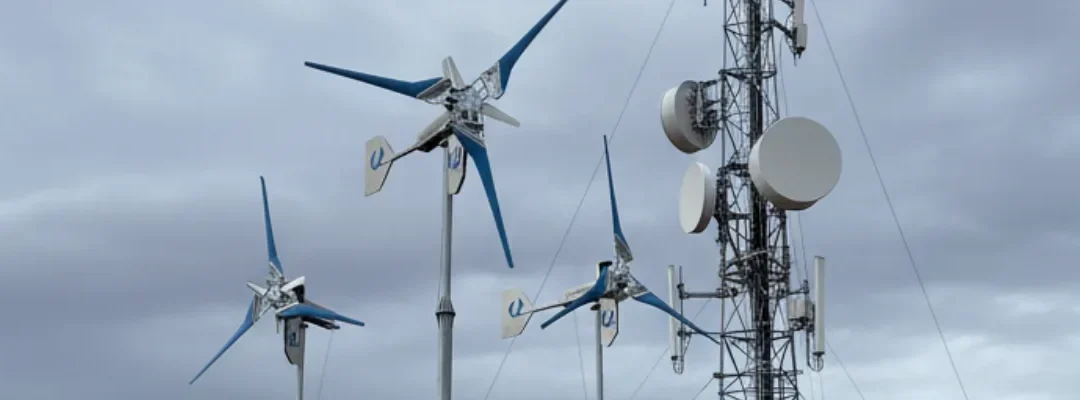
Remote telecom towers and other remote infrastructure need reliable power every day. If the power supply is weak, the whole system can face problems. This is why small wind can be useful in these locations. In India, small wind systems have been linked with telecom towers, remote areas, and wind-solar hybrid systems in official and research documents. NIWE has also noted that small wind and wind-solar hybrids are finding applications on telecom towers and in remote border and mountain locations.
Why is power a big issue at remote sites
A telecom tower or remote infrastructure site cannot stop working just because the grid power is weak. These sites often need steady power for communication equipment, controls, and other basic operations. An MNRE presentation on remote telecom sites in India explains that power availability at remote locations is a major issue, that power is one of the main problems for telecom base stations, and that grid extension is often not commercially viable for low-load remote BTS sites.
What can small wind do?
A small wind turbine can generate electricity near the site where the power is needed. That makes it useful for remote locations where power is difficult, costly, or unreliable. WRI India describes small wind turbines as flexible renewable systems that can be used in remote areas and at telecommunication towers, especially where large wind projects are not suitable.
Why telecom towers are a good fit
Telecom towers are a good fit for small wind because they usually have a clear power need, and many are located away from a strong grid supply. MNRE’s telecom presentation says remote telecom sites often use diesel generators and that wind-solar hybrid systems can be a better and viable substitute in such cases. That is why small wind is important here. It can help reduce diesel use and support more dependable power at the site.
Why hybrid systems make more sense
In many remote projects, small wind works best with solar rather than alone. The Government of India’s Small Wind Energy and Hybrid Systems programme was created to promote small wind and wind-solar hybrid systems, including off-grid electricity generation and demonstration projects. This is important because solar and wind can support each other at different times. A hybrid system can give more balanced power for telecom towers and other remote assets.
Remote infrastructure can also benefit
This is not only about telecom towers. Remote infrastructure can include border locations, mountain sites, small stations, monitoring points, public facilities, and other isolated systems that need regular power. NIWE has specifically mentioned remote border areas and mountain locations as places where small wind and wind-solar hybrids are finding applications.
Where small wind makes sense
Small wind for telecom towers and remote infrastructure makes sense where there is a real power need, limited grid support, and enough wind at the site. It is more suitable in open and exposed locations than in crowded built-up areas. WRI India notes that small wind can be placed where there is a reasonable wind resource but where large wind projects are not suitable.
Where it may not work well
Small wind will not work well at every site. If the wind is poor, blocked, or too uneven, the output may not be good enough. If the site has no proper wind study, the system may not perform as expected. That is why small wind should not be chosen just because the site is remote. It should be chosen because the site has the right wind conditions and the right power needs. WRI India says these systems are site-dependent and best suited to places with a reasonable wind resource.
The main value of small wind at remote sites
The main value is simple. Small wind can bring local power to sites that are hard to serve. For telecom towers and remote infrastructure, that can mean less diesel use, better energy support, and a cleaner power option when used in the right place. When combined with solar, the system can become even more practical for remote operations. Official Indian programme documents support this hybrid approach for off-grid and local power applications.