
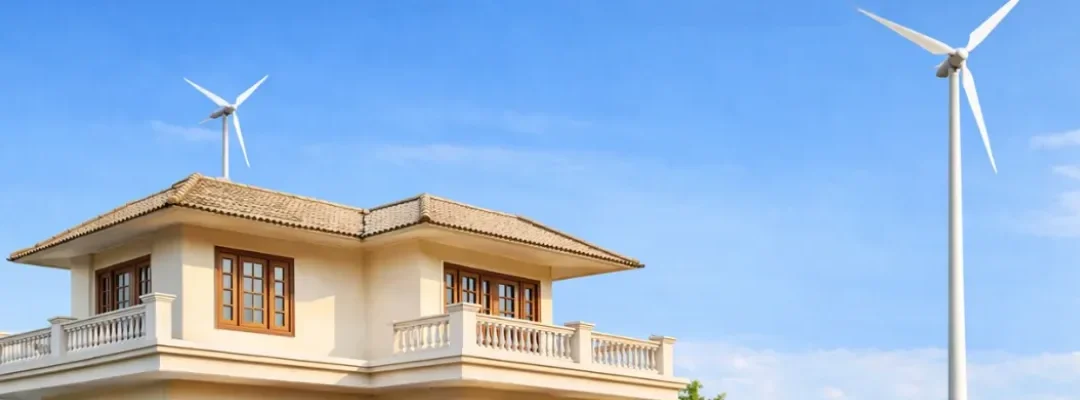
When people plan a small wind system, one common question comes up: Should the turbine go on the rooftop or on a tower?
Both options use wind to make electricity, but they are not equal in performance. In most cases, a tower-mounted wind turbine is the better choice because it gets cleaner wind and usually gives better output. Rooftop systems can work in some places, but they are more limited. The right choice depends on the site, the wind, and the building.
What is a rooftop wind turbine?
A rooftop wind turbine is a small wind turbine installed on top of a building. People like this idea because it does not need extra land and may look easier to install. It can seem like a smart option for homes, offices, schools, and commercial buildings that want clean energy on-site. But a roof is not always a good wind location just because it is higher than the ground.
What is a tower-mounted wind turbine?
A tower-mounted wind turbine is installed on a separate tower away from the main building. This setup places the turbine higher and farther from obstacles like walls, trees, tanks, and nearby buildings. The U.S. Department of Energy says higher towers usually help turbines produce more power because wind speeds increase with height and turbulence is lower above obstructions.
The biggest difference is wind quality
This is the most important point.
A wind turbine does not only need wind. It needs smooth and steady wind. On rooftops, wind often becomes disturbed because it moves around the shape of the building and nearby structures. NIWE notes that rooftop small wind turbines can face higher turbulence due to building aerodynamics, and DOE guidance says rooftop mounting is generally not recommended because of turbulence and related issues.
A tower-mounted turbine usually gets cleaner airflow. That is why it often performs better than a rooftop turbine, even when both are installed at the same site.
Which one gives better performance?
In most cases, the tower-mounted turbine gives better performance.
Why? Because better wind means better energy output. A tower can raise the turbine above the disturbed air that exists close to buildings and trees. DOE guidance says the tower not only increases height, but also lifts the turbine above near-ground turbulence caused by obstacles.
A rooftop turbine may spin often, but that does not always mean strong power generation. If the airflow is uneven, the output can be lower than expected.
Which one is better for the building?
A rooftop turbine puts the wind system directly on the building. This can create concerns about vibration, noise, and structural loading. DOE says rooftop mounting can create noise and structural problems, and NIWE also notes that rooftop wind systems can have higher mechanical noise.
A tower-mounted turbine keeps the machine separate from the building. This usually makes structural planning easier and reduces the chance of vibration affecting the building itself.
Which one is easier to install?
At first, a rooftop turbine may seem easier because the building is already there. But the roof must still be checked carefully. The structure must carry the turbine, support frame, and wind load safely. If the building is not suitable, installation becomes difficult. NIWE guidance for small wind says structural analysis and load-bearing capacity should be checked before installation.
A tower-mounted turbine needs land, foundation work, and tower installation. So it may need more space and more civil work. But even with that, it often gives a better long-term result because the wind conditions are usually better.
Which one is better for maintenance?
Maintenance access is also important.
A rooftop turbine may be harder to reach, especially on busy commercial buildings or tall structures. A tower-mounted system can also need proper access planning, but it is usually designed with service needs in mind from the start. Good maintenance is important in both cases, but easier access often helps reduce downtime and service difficulty.
Which one is better in cities?
In many city locations, rooftop wind sounds attractive, but the surroundings often make it a weak choice. Tall buildings, narrow spaces, and blocked airflow create poor wind conditions. NIWE and DOE both point to turbulence near buildings as a major issue for rooftop wind.
If a city site has limited space and poor wind, a rooftop turbine may not give useful results. In such cases, another renewable option may be more practical.
When can a rooftop wind turbine make sense?
A rooftop wind turbine can make sense if the building is in an open, windy area, the roof is strong enough, and there are not many nearby obstacles. It must be based on a real site study, not only on available space. MNRE says wind is site-specific, so proper resource assessment is essential before choosing a location.
So rooftop wind is possible, but it works best only in selected cases.
When is a tower-mounted turbine the better choice?
A tower-mounted turbine is usually the better choice when the goal is stronger performance, cleaner wind, and more stable output. It is especially useful when the site has open land and enough room to place the turbine away from the building. DOE guidance strongly supports the value of extra tower height for better wind capture.