
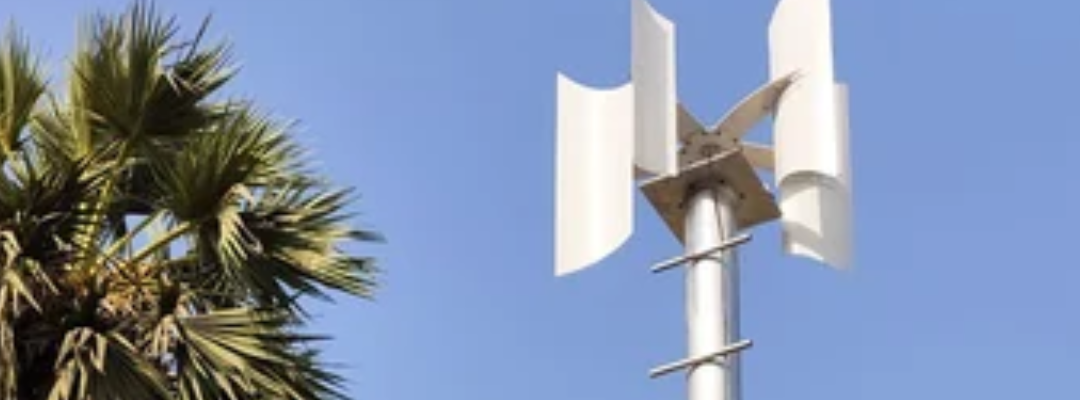
India needs more clean energy. Power demand is rising, and many businesses want to lower energy costs and reduce dependence on diesel and unstable grid power. Wind energy is already a big part of India’s renewable energy mix. As of 28 March 2026, India had about 55.13 GW of installed wind power capacity. The government also says India has very large wind potential, with an estimated 695.5 GW at 120 meters and 1163.9 GW at 150 meters above ground level.
When most people think about wind energy, they think about very large wind farms. But there is another side of the market that deserves more attention: small wind turbines. In India, small wind turbines are generally treated as systems of up to 100 kW. They are used for local power needs such as rural electrification, telecom towers, water pumping, community lighting, and grid-connected or hybrid systems.
What is small wind?
A small wind turbine is a smaller power system that makes electricity from wind close to where that electricity is used. Instead of sending large amounts of power to the grid like a wind farm, a small wind system is usually built for a home, farm, school, business site, telecom tower, resort, campus, or remote facility.
This is why small wind is important. It brings power closer to the load. That can help reduce power bills, improve energy reliability, and support cleaner operations at the same time.
Why India has strong potential for small wind
1. India already has a strong wind base
India is not new to wind energy. The country already has a large wind sector, strong policy interest, and a long history of wind resource assessment. MNRE says NIWE has installed more than 900 wind-monitoring stations across the country and has prepared wind maps at several hub heights. That gives India a strong base for identifying places where wind projects can work.
This matters for small wind because wind is site-specific. A turbine works well only when the site has the right wind conditions. India already has the institutions and data needed to study that.
2. Small wind can help where grid power is weak
In many parts of India, grid power is still unreliable or expensive for remote loads. Small wind can help in such places, especially when diesel is the backup option. NIWE has listed applications like rural electrification, telecom towers, water pumping, and community lighting. These are exactly the kinds of sites where local power generation can make a real difference.
For these users, the value of small wind is not only power generation. It is also about energy security.
3. Wind and solar work well together
One of the biggest reasons small wind has potential in India is that it does not need to work alone. India’s National Wind-Solar Hybrid Policy says wind and solar resources are complementary, and hybrid systems can reduce variability and improve grid stability. The policy also allows battery storage to be added.
This is a big advantage. Solar gives strong output in sunny hours. Wind may be produced at different times, including evenings, nights, or seasons when the solar is weaker. When both are combined, the system can give more balanced energy.
That is why small wind has big potential in India, not just as a stand-alone product, but as part of a hybrid energy system.
Where small wind can work best in India
Small wind will not fit every site. But it can work well in the right places.
Farms and water pumping
Many farms need power for water pumping and other daily work. NIWE has specifically listed water pumping as a suitable use for small wind systems. In windy areas, this can lower fuel use and support more reliable farm operations.
Telecom towers and remote sites
Telecom sites often need dependable power in places where the grid is weak. Small wind can support these sites, especially when it is part of a wind-solar-battery setup. NIWE has identified telecom towers as one of the practical uses of small wind in India.
Campuses, resorts, and institutions
Large campuses, schools, resorts, and institutions with open land and regular power demand may also benefit from small wind. If the site has good wind and a real need for on-site generation, small wind can be a useful part of the energy mix. This becomes even more attractive when the goal is to cut energy costs and use cleaner power.
Commercial and industrial hybrid systems
For some business users, solar alone may not be enough. A hybrid setup can offer better balance and better use of available land and power infrastructure. The wind-solar hybrid policy was created around exactly this logic: better use of renewable resources, land, and transmission systems, with lower variability.
What will decide success?
Small wind has big potential in India, but success depends on using it in the right way.
First, the site must have a good wind resource. Wind turbines are not “install anywhere” products. MNRE clearly says wind is intermittent and site-specific, so resource assessment is essential before selecting a site.
Second, the project must match the actual energy needs. A small wind turbine should be chosen based on load, location, and operating pattern.
Third, system design matters. In many cases, the best answer is not just a turbine. It is a complete wind system that may include solar, storage, controls, and smart integration.
Why this matters for the future
India is pushing for more renewable energy, and wind capacity is still growing fast. That creates a strong environment for new wind solutions. Small wind can support this growth by serving sites that large wind farms cannot directly serve. It can bring clean power to the edge of the grid, to remote users, and to businesses that want more control over their energy.
In simple words, small wind has big potential in India because it can solve real problems:
- high energy costs,
- weak grid supply,
- diesel dependence,
- and the need for cleaner power.
How Synergy can help
At Synergy, we provide wind systems designed for real site needs. We believe small wind works best when it is planned carefully, based on local wind conditions, load needs, and long-term performance goals.
For the right site, a small wind system can do much more than generate electricity. It can help reduce energy costs, improve reliability, and support cleaner operations.