
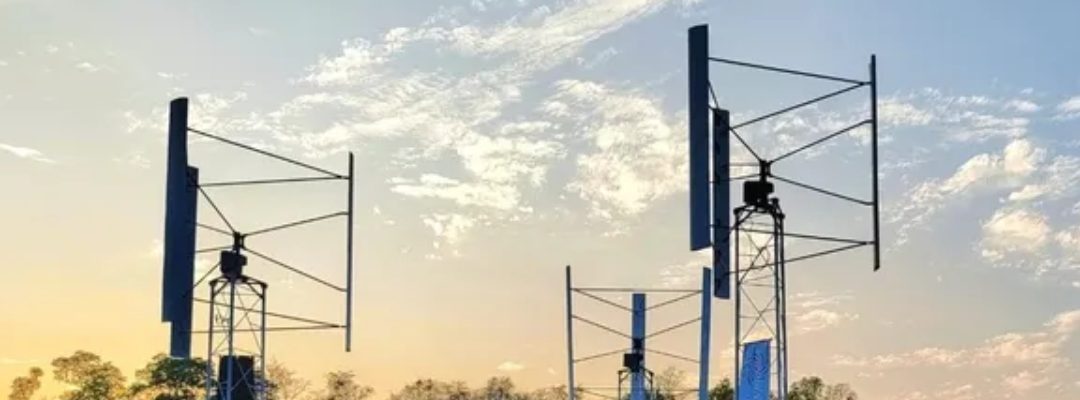
India’s wind sector is already large and still growing. According to MNRE, the country’s cumulative wind power capacity reached about 55.13 GW by March 2026, and NIWE’s wind resource assessments continue to show strong onshore potential across India. But wind in India is not only about massive utility-scale wind farms. In the right locations, small wind turbines can play a practical role in distributed energy, diesel displacement, and hybrid renewable systems.
What are small wind turbines?
Small wind turbines are compact wind energy systems designed to generate electricity close to where it is used. In the NIWE programme material, India’s small wind segment has been described as turbines of up to 100 kW, with applications such as community lighting, rural electrification, telecom towers, water pumping, and grid-tied systems. In simple terms, they are meant for localized energy needs rather than utility-scale power export.
For businesses and institutions, that makes small wind less about “selling power to the grid at scale” and more about reducing electricity costs, improving resilience, and supporting clean-energy goals at the site level. This is especially true when the turbine is part of a broader wind-solar-battery solution instead of a stand-alone installation.
Small wind is not the same as large wind
Large wind farms are built around utility-scale generation, grid evacuation, and high-wind corridors. Small wind turbines, by contrast, are usually built around a specific site load: a farm, a school, a telecom location, a campus, a remote facility, or an industrial user with steady power demand.
That difference matters because wind is intermittent and site-specific. MNRE states clearly that wind resource assessment is essential for selecting viable sites. In other words, a small wind turbine is only as good as the wind available at its exact location.
Where do small wind turbines fit in India?
1. Remote and weak-grid locations
Small wind turbines fit best where grid reliability is poor or where extending the grid is expensive. NIWE has long identified use cases such as rural electrification, community lighting, and remote power applications. In these cases, the value is not only in generating electricity but in reducing dependence on diesel and improving energy availability for essential loads.
2. Farms and water pumping applications
Agriculture remains one of the most sensible use cases for distributed wind in the right microclimates. NIWE materials specifically list water pumping as an application area for small wind systems. For farms with suitable wind conditions, this can support irrigation, reduce fuel costs, and add another renewable source alongside solar pumps or battery-backed systems.
3. Telecom, border, and critical infrastructure sites
Small wind and wind-solar hybrid systems have also been associated with telecom towers, rail-related loads, and remote institutional or strategic sites in NIWE presentations. These are locations where continuity of power is valuable, diesel logistics are costly, and a hybrid renewable setup can be operationally attractive.
4. Campuses, resorts, ports, and industrial sites in windy regions
NIWE’s wind atlas identifies high-potential regions across Andhra Pradesh, Gujarat, Karnataka, Maharashtra, and Tamil Nadu, with additional scattered potential elsewhere. That means small wind can make sense for selected commercial and industrial sites in windy belts, especially where there is daytime and evening load, enough open space, and a real need for on-site generation.
5. Wind-solar hybrid projects
This is where small wind often makes the most practical sense in India. The National Wind-Solar Hybrid Policy notes that solar and wind resources are complementary in India and that hybridization can reduce variability while making better use of land and transmission infrastructure. Battery storage can also be added to further smooth output and improve reliability.
For many sites, that means the question is not “solar or wind?” but “what is the right hybrid mix?” A site with strong summer solar output and stronger monsoon or evening wind can benefit from combining both resources rather than relying on a single generation source.
Where small wind usually does not fit
Small wind turbines are not a universal rooftop product. NIWE has noted that rooftop small wind applications can face higher turbulence and mechanical noise because they operate close to the ground and near building aerodynamics. That is why many urban rooftops, despite looking convenient, are often not ideal unless the local wind regime and mounting conditions are carefully validated.
In practice, small wind is usually a weak fit when:
- The site has low or highly turbulent wind,
- There are surrounding buildings or obstructions,
- The available load is too small or too inconsistent,
- Solar alone can meet the requirement more economically.
That is why project success depends on resource assessment, system design, and realistic performance expectations rather than generic product claims.
So, where does small wind fit in India today?
Small wind turbines fit in India as a targeted distributed-energy solution. They are strongest in sites that have three things at the same time:
- Good wind resource
- A meaningful on-site load
- A reason to improve reliability or reduce diesel/grid dependence
That makes them relevant for selected farms, telecom locations, campuses, institutional sites, industrial users, and remote facilities—especially in windy states and especially when paired with solar and storage. The role of small wind is not to replace large wind farms. It is to serve the right load in the right place with the right system architecture.
How Synergy helps
At Synergy, we believe small wind works best when it is engineered around the site, not forced onto it. We provide wind systems and hybrid renewable solutions designed for real operating conditions, real load profiles, and real commercial outcomes.
That means looking at:
- wind resource and site feasibility,
- hybrid integration with solar and storage,
- equipment selection,
- energy yield expectations,
- and long-term system performance.
In today’s India, the best small wind projects are not the biggest ones. They are the ones that are properly matched to the site.